← All guides · Pricing
See what it's worth
Read the sold-price comps and the recommended list price, and understand where the numbers come from.
Updated
What you'll end up with
For any item with a manufacturer and catalogue number, a Sold-price comps panel showing what the same model actually sold for on eBay recently, a recommended list price with eBay's fees and your postage already taken off, and — if you've entered a purchase price — the margin you'd make at that price.
Across your whole stock, the Price Intel page lists every live listing whose price is out of step with its comps, so you can reprice the ones that matter in one sitting.
Steps
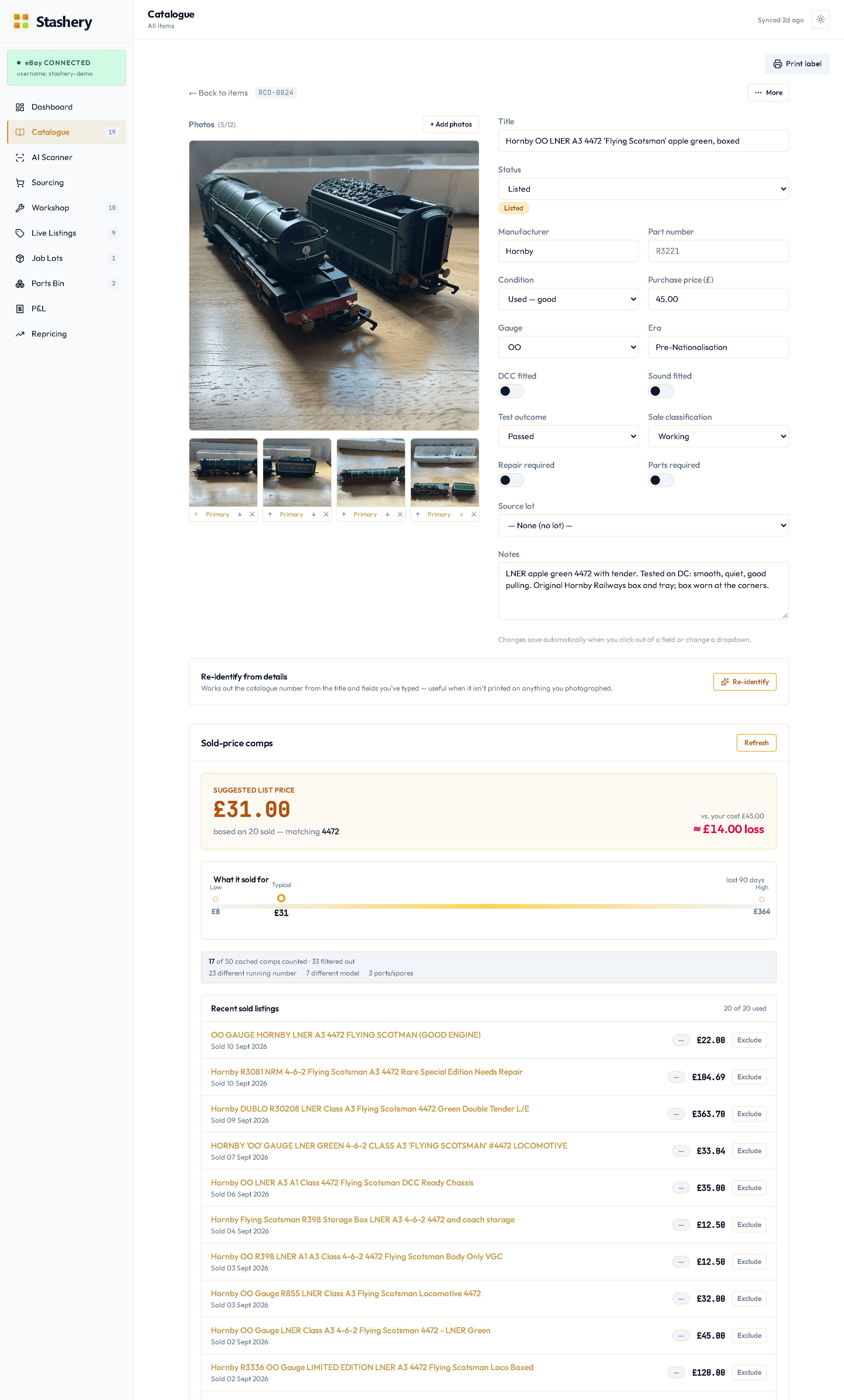
- Open an item. The comps panel is on the right (website) or below the photos (app).
- The first time an item is viewed, Stashery searches eBay's sold listings for that model and shows the results. This takes a few seconds.
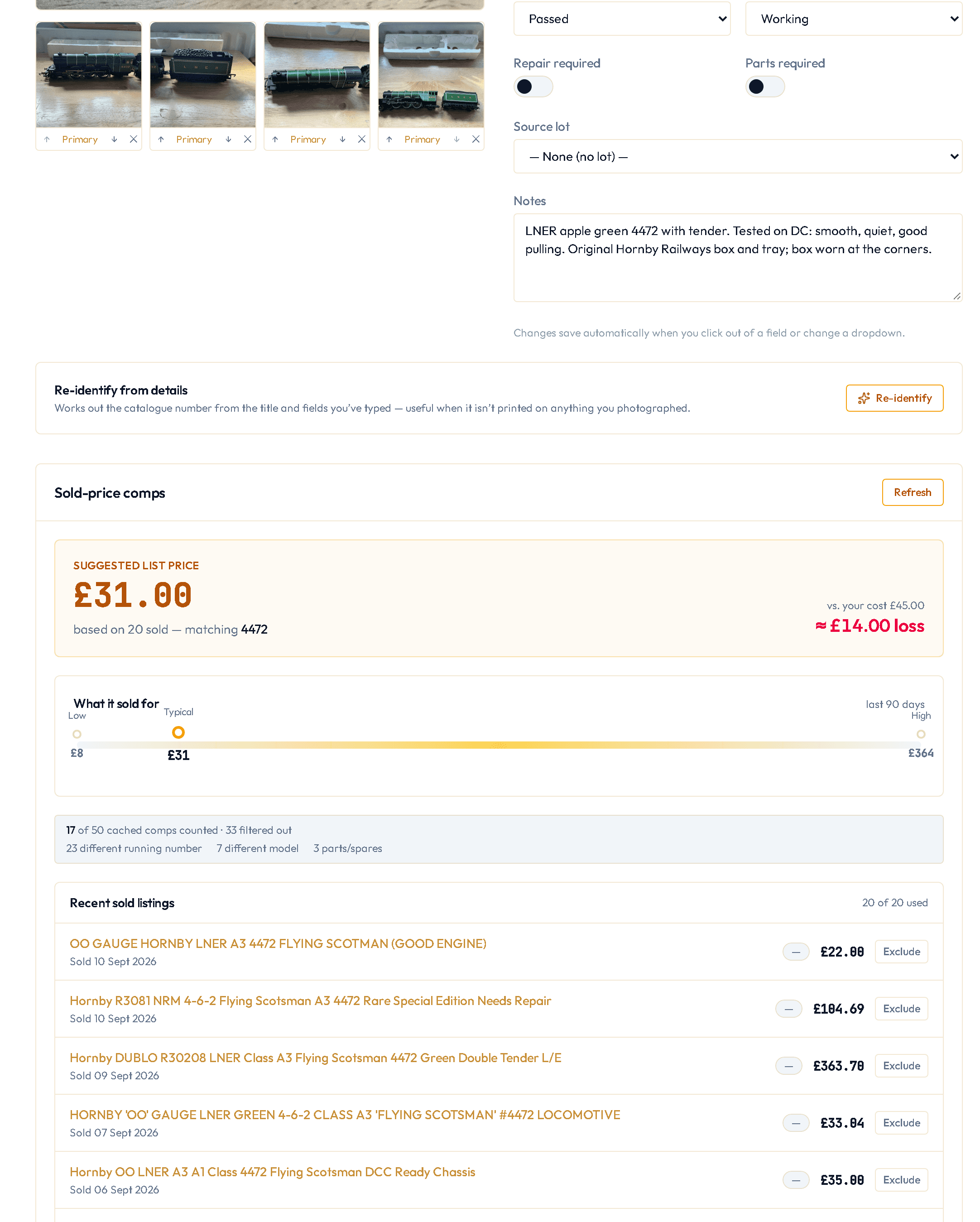
- Read the panel: the sales it found, with date and price; the median; the recommended price; and, if you've set a purchase price, the margin at that price.
- Use the breakdown link to see how the recommendation was reached — which sales counted, which were left out (wrong model, job lot, spares), and the fee and postage assumptions.
- If the comps look wrong for the model, check the item's catalogue number — that's the key Stashery searches by. Fix it and the panel re-searches.
- Press Refresh only if you think the market has moved. Stashery keeps the sales it has already found and tops up with newer ones; it doesn't throw the old ones away.
What you'll see
The recommended price is net: it starts from the median sale price and removes eBay's final-value fee, the regulatory fee, and the postage you charge, using the fee model for your account type (private or business). The panel says which it's using. If you've told Stashery your purchase price, the margin is shown in pounds, not just a percentage.
If something goes wrong
"Add a manufacturer or catalogue number to see comps." The item has neither. Stashery won't search on a brand alone — "Hornby" would pool a Flying Scotsman with a wagon and give you a confidently wrong number. Add the catalogue number (or use Re-identify to find it).
The comps are for the wrong model. Nearly always the catalogue number. Check it against the box or the underside. Coaches and wagons without a class are matched on their type (brake van, Mk1 coach) and running number where the title has one.
Only two or three sales, and the price looks low or high. Thin pools happen for rare models. The breakdown tells you how many sales it's working from; treat a recommendation from fewer than five with judgement.
A sale I know about isn't in the list. eBay's sold data reaches back about 90 days; older sales won't appear. If it's recent and missing, the title probably didn't contain the catalogue number — the breakdown shows what was searched.